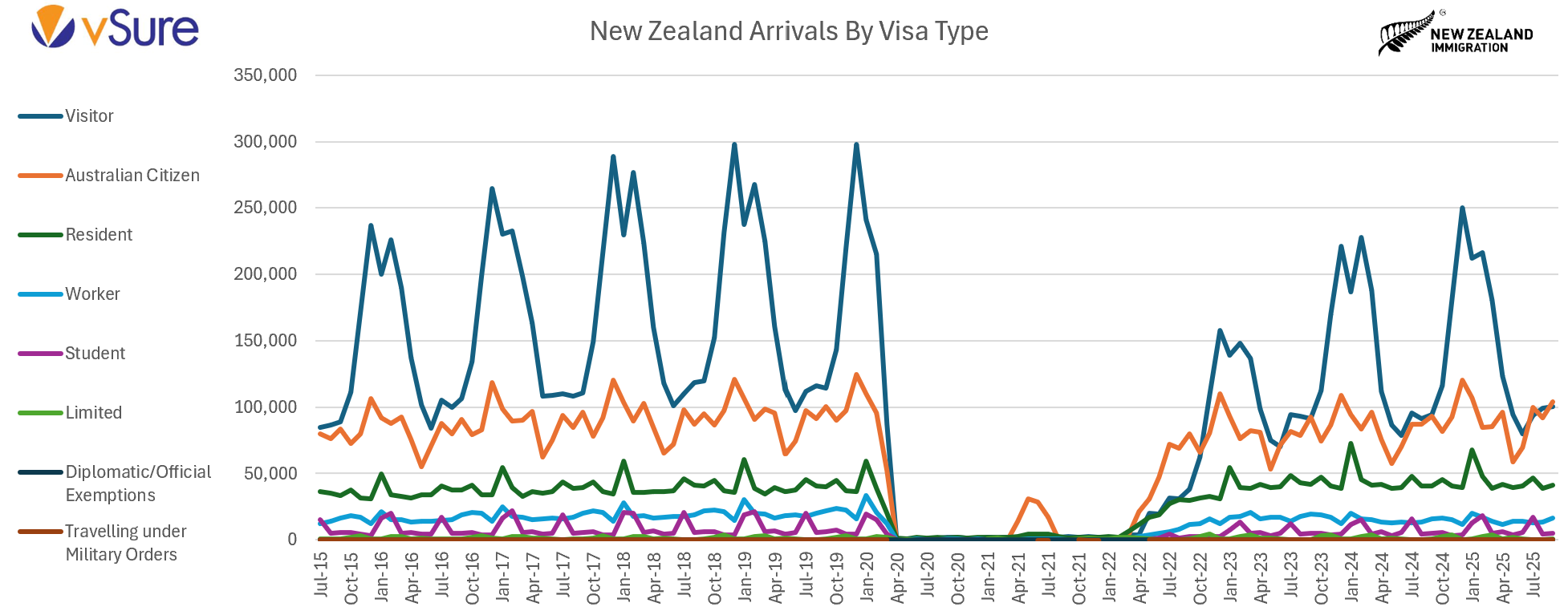
For most of the last decade, Australia has been the default answer when a student from India, China, Vietnam or the Philippines asked "where in Oceania should I study?" That default is being tested. Since 2023, Canberra has spent two years deliberately cooling international student demand — and the numbers are starting to show it. At the same time, Immigration New Zealand's own decision data suggests Wellington is quietly doing the opposite: rebuilding volume, holding approval rates steady, and openly targeting growth.
We pulled Immigration New Zealand's student visa decision statistics (financial years 2016/17 through July 2026) and lined them up against the latest publicly reported Australian visa data. Here's what the two trend lines actually look like.
New Zealand: a five-year recovery that's now overshooting
INZ decides student visa applications — approving or declining them — across every financial year (July to June). Looking at total decisions made each year tells a clear story:
| Financial Year |
Approved |
Declined |
Total Decided |
Approval Rate |
| 2016/17 |
106,708 |
11,829 |
118,537 |
90.0% |
| 2017/18 |
104,764 |
7,971 |
112,735 |
92.9% |
| 2018/19 |
103,837 |
7,948 |
111,785 |
92.9% |
| 2019/20 |
83,733 |
9,432 |
93,165 |
89.9% |
| 2020/21 |
52,082 |
1,635 |
53,717 |
96.9% |
| 2021/22 |
39,693 |
1,429 |
41,122 |
96.5% |
| 2022/23 |
68,201 |
7,385 |
75,586 |
90.2% |
| 2023/24 |
77,851 |
12,204 |
90,055 |
86.4% |
| 2024/25 |
81,026 |
12,418 |
93,444 |
86.7% |
| 2025/26 |
93,137 |
10,743 |
103,880 |
89.7% |
Source: Statistics :: Immigration New Zealand
The pandemic-era collapse to just 41,122 decisions in 2021/22 is the low point — border closures did the damage you'd expect. What matters more is the shape of the recovery since. Total decisions climbed every single year from 2021/22 to 2025/26, more than doubling (+152%) off that trough, and 2025/26 came in 11.2% higher than the year before it. New Zealand is now back to roughly 88–93% of its 2016–2019 pre-COVID decision volumes, and the trajectory has not flattened.
The approval rate tells a second, quieter story. It dipped through 2023/24 and 2024/25 (down to 86.4–86.7%, likely reflecting tighter scrutiny as volumes rebuilt), then recovered to 89.7% in 2025/26 — growth in both volume and approval rate at the same time, not one at the expense of the other.
This lines up with what Education New Zealand has been reporting independently: enrolments hit 92,580 in 2025 (up 11% year-on-year and 80% of the pre-COVID peak), applications received in 2026 are running roughly 20% ahead of the same period in 2025, and the government's own "International Education Going for Growth" plan targets 105,000 enrolments by 2027 and 119,000 by 2034.
Which markets are driving it
Breaking the nationality data down by financial year shows growth isn't evenly spread — a handful of markets are doing most of the work:
| Nationality |
2024/25 decided |
2025/26 decided |
Change |
| Bangladesh |
1,376 |
3,617 |
+163% |
| Fiji |
1,640 |
2,599 |
+59% |
| Philippines |
5,201 |
6,733 |
+29% |
| Vietnam |
2,375 |
2,827 |
+19% |
| India |
17,917 |
19,694 |
+10% |
| China |
22,182 |
24,128 |
+9% |
| United States |
2,860 |
3,280 |
+15% |
| Sri Lanka |
5,823 |
5,935 |
+2% |
| Nepal |
4,273 |
3,921 |
-8% |
| Thailand |
2,216 |
1,821 |
-18% |
Source: Statistics :: Immigration New Zealand
China and India remain the two largest source markets by a wide margin, together accounting for roughly 42% of all decisions in 2025/26. But the standout growth stories — Bangladesh, Fiji, the Philippines, Vietnam — suggest New Zealand's promotional push into newer or underpenetrated markets is landing, even as a couple of established markets (Nepal, Thailand) cooled slightly.
Australia: a deliberate, multi-year cooldown
Australia's numbers are moving in close to the opposite direction, and it isn't accidental. Since late 2023, Canberra has stacked up a series of measures explicitly designed to bring international student numbers down from their post-COVID boom: a tougher "Genuine Student" requirement introduced in March 2024, a AUD$2,000 student visa application fee, shortened post-study work rights, higher financial-proof thresholds, and Ministerial Direction 111, which slows visa processing once a provider is judged to have reached its allocation.
The effect is now visible in the grant data. Industry analysis from ApplyBoard puts total offshore, primary-applicant tertiary visa grants at around 190,000 for calendar 2025 — 12% down on 2024 — with Q1 2026 running a further 8% behind Q1 2025. ICEF Monitor's review of full-year 2025 Department of Home Affairs data shows overall grants down 2% on 2024, with K-12 school visas down 17% year-on-year (28% below 2019) and the English-language (ELICOS) sector recording its weakest six months of visa grants in twenty years.
Grant rates — the share of applications actually approved — have fallen even more sharply than volumes. Reporting on Department of Home Affairs figures shows the higher education grant rate dropping to 67.6% in February 2026 and then to a record low of 59% in March 2026, down from historical norms above 85%. Refusal rates for some of Australia's largest source markets spiked in the same month: around 51% of applications from India and Bangladesh were refused, and Nepal's refusal rate reached 73%.
Canberra has signalled some easing for 2026 — the enrolment cap was lifted 9% to 295,000 places, and a couple of student categories were carved out of the cap entirely — but analysts are cautious about reading this as a genuine reversal. The consensus view, including from sector commentary in The Conversation, is that 2026 will still be a tough year for Australian international education, particularly in vocational training, where offshore applications in the first half of 2025 were down 75% on 2023.
Two countries, two very different signals
Put side by side, the pattern is stark:
- Volume: New Zealand's total decisions are up double digits year-on-year and climbing back toward pre-COVID levels; Australia's grants are down for a second consecutive year.
- Approval rate: New Zealand's is recovering (86.4% → 89.7% over two years); Australia's has fallen off a cliff in specific sectors, with higher education grant rates as low as 59% in early 2026.
- Policy direction: New Zealand has an explicit, published growth target (105,000 by 2027, 119,000 by 2034) backed by faster processing and expanded post-study work rights; Australia's settings remain built around caps, fees and stricter genuine-student screening, even after a modest 2026 easing.
- Market mix: New Zealand is seeing outsized growth from markets like Bangladesh, Fiji, the Philippines and Vietnam — some of the same markets facing the sharpest refusal-rate increases in Australia.
None of this means Australia is closing its doors, and a single year of rising applications doesn't guarantee New Zealand will hit its 2027 or 2034 targets — visa applications don't automatically become enrolments, and global student mobility patterns can shift quickly. But for students, agents and institutions weighing where to place their bets, the direction of travel matters as much as the absolute numbers, and right now those directions are pointing opposite ways.
Sources